- From Emmy Award-winning filmmaker Ric Esther Bienstock, new two-part POV documentary Speechless will broadcast commercial-free Tuesday, April 14 and Wednesday, April 15 on CBC TV.
- The Sunday Magazine’s Piya Chattopadhyay will host an interview with Bienstock following the commercial-free broadcast on April 14. Following the second part of the documentary on April 15, Chattopadhyay will host a panel conversation discussing the topics explored in the documentary.
CBC today announced the premiere of two-part POV documentary Speechless (2x90) from Emmy Award-winning filmmaker Ric Esther Bienstock (Enslaved, Tales From the Organ Trade) and Academy Award-winning executive producer Alex Gibney (Taxi to the Dark Side). Filmed on campuses in the U.S. and the U.K., the documentary brings together years of investigation and on-the-ground filmmaking to chronicle one of the most polarizing cultural shifts of our time. Speechless will broadcast commercial-free on CBC on Tuesday, April 14 and Wednesday, April 15 at 8 p.m. (8:30 NT), and will also be available to stream on CBC Gem as of 9 a.m. ET on Tuesday, April 14. A CBC and documentary Channel Original produced in association with BBC, Speechless will also premiere in the U.K. on BBC Storyville and iPlayer.
The Sunday Magazine’s Piya Chattopadhyay will host an interview with filmmaker Bienstock at 9:30 p.m. (10 NT) on CBC TV following the commercial-free broadcast on April 14. Following the second part of the documentary on April 15, at 9:30 p.m. (10 NT) Chattopadhyay will host a panel conversation discussing the topics explored in the documentary.
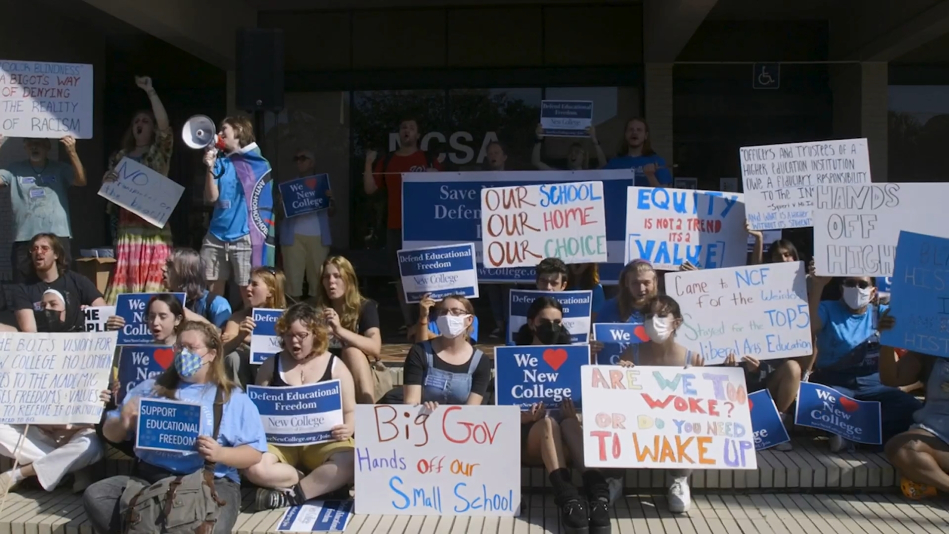
For Speechless, Bienstock embedded herself inside some of the most divisive ideological conflicts reshaping higher education, following students, professors and administrators at institutions including Harvard, Cornell, Yale, Penn State, Evergreen State College, Stanford, the University of Sussex and New College of Florida. What emerges is an investigation into how debates over race, gender and social justice have evolved into a wider culture war, reshaping norms around free expression and fuelling viral outrage, professional fallout, and institutional upheaval.
“I wanted to challenge viewers, regardless of where they fall politically, and to reflect on what’s at stake when we lose the ability to speak across differences,” said Bienstock. “My hope is that Speechless will remind us that disagreement is not a threat; it’s a feature of democracy. The danger comes when we stop speaking to each other altogether.”
“As the national public broadcaster, we strive to inspire conversations and foster connections between different perspectives. In an era of increasing polarization, Speechless explores the vital need to bridge those gaps and ensure we are truly hearing each other,” said Jennifer Dettman, Executive Director, Unscripted Content, CBC. “We hope Ric’s thoughtful documentary encourages healthy dialogue and reflection.”
Speechless features voices across the ideological spectrum, from progressive organizers and critics of campus orthodoxy to conservative activists and institutional challengers, revealing contradictions, blind spots and unintended consequences on all sides. Blending verité filmmaking with raw protest footage, insider testimony, archival material, viral social media and animation, the documentary poses the urgent question: What happens when a society loses the ability to tolerate disagreement and power decides who gets to speak?
A CBC and documentary Channel Original, Speechless is a Good Soup Productions presentation, produced by Bienstock and Garfield Miller, and edited by Graeme Ball. The executive producers are Alex Gibney, Mette Hoffmann-Meyer and Randi Kirshenbaum. Presented by The Why Foundation in association with BBC Storyville. Produced with the participation of Rogers Cable Network Fund, Ontario Creates, and, Rogers Documentary Fund, and with the assistance of the Ontario Film and Television Tax Credit, and Canadian Film or Video Production Tax Credit. For CBC, Sally Catto is General Manager of Entertainment, Factual and Sports; Jennifer Dettman is Executive Director of Unscripted Content; Sandra Kleinfeld is Senior Director, Documentary; and Ann-Marie Redmond is Executive in Charge of Production.
-30-
About Ric Esther Bienstock
Bienstock is widely regarded as one of Canada’s most accomplished investigative documentarians. Her extensive body of work includes Enslaved: The Lost History of the Transatlantic Slave Trade with Samuel L. Jackson, The Accountant of Auschwitz, Tales From the Organ Trade, Sex Slaves, Ebola: Inside an Outbreak, Boxing: In and Out of the Ring, Penn & Teller’s Magic and Mystery Tour and Ms. Conceptions. Her films have screened at more than 80 international festivals and aired globally on networks including Netflix, HBO, PBS, CNN, Discovery, National Geographic, A&E, TLC, Amazon, EPIX, CBC, History Channel, Channel 4, BBC, ITV and ZDF/Arte.
In September 2024, Bienstock received a Silver Circle Emmy Award in New York, recognizing 25 years of significant and impactful contributions to the industry. She has been appointed an Officer of the Order of Canada for raising awareness of global events and conflicts through film, and was awarded the Gordon Sinclair Award for Broadcast Journalism for her exceptional body of work and contribution to the international profile of Canadian television journalism. Her many honours include an Emmy Award for Outstanding Investigative Journalism, two Edward R. Murrow Awards, a Dupont-Columbia Award, a British Broadcast Award, multiple Canadian Screen Awards, Donald Brittain Awards, Geminis, a Genie, a Royal Television Society Award, a BAFTA nomination and two Amnesty International Awards.
About CBC/Radio-Canada
CBC/Radio-Canada is Canada’s national public broadcaster. Through our mandate to inform, enlighten and entertain, we play a central role in strengthening Canadian culture. As Canada’s trusted news source, we offer a uniquely Canadian perspective on news, current affairs and world affairs. Our distinctively homegrown entertainment programming draws audiences from across the country. Deeply rooted in communities, CBC/Radio-Canada offers diverse content in English, French and eight Indigenous languages: Dëne Sųłıné, Dene Kǝdǝ́, Dene Zhatıé, Eastern Cree, Dinjii Zhuʼ Ginjik, Inuktitut, Inuvialuktun and Tłı̨chǫ. We also deliver content in Spanish, Arabic, Chinese, Punjabi and Tagalog, as well as both official languages, through Radio Canada International (RCI). We are leading the transformation to meet the needs of Canadians in a digital world.